

I got into an argument about Marty Supreme the other day. My friend said there was no point to the movie without Timotheé Chalamet’s character going through some sort of change at the end. But I,
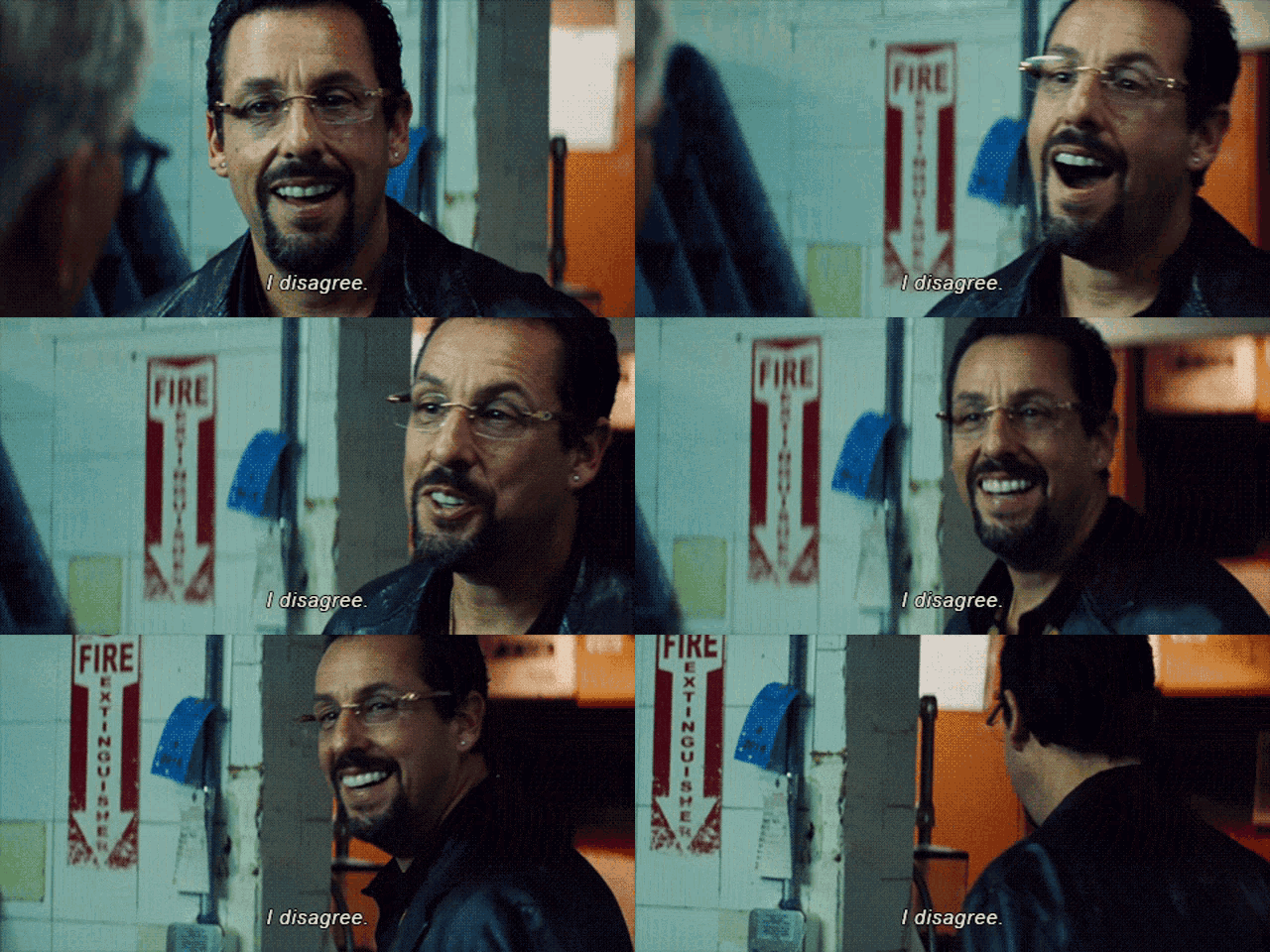
One more time for everyone not paying attention in the back of the room: SPOILERS INBOUND for the world’s biggest letdown of a holiday release.1
Marty goes through trials and travails but remains focused on his one goal: to be the best ping pong player in the world. He cares about others to the point where he doesn’t want to accidentally maim them. He cares about money, but it’s not particularly motivating for him outside of getting him where he needs to go. He cares about his not-girlfriend inasmuch as a means to sexual and personal gratification—and her not dying. Truly, all he wants is real validation of what he knows: that he is the best ping pong player in the world in spite of being one of its worst humans.
When Marty finally does beat his rival Endo, he is not smug, because that is actually not part of his ambitious character. Rather he is relieved and full of catharsis, because his reality has validated his dream: Marty reigns supreme over ping pong players across the globe.
What is interesting about Josh Safdie’s film, though, is that the catharsis does not arrive entirely when it should. Yes, we get a whiff of it when Marty beats Endo in the “real” rematch. But Marty’s literal discharge of emotion occurs when he sees his child: he starts crying. Are they tears of happiness for his newly christened fatherhood?
Mazel, etc., but no.
Marty finally cries when he sees his child because his dream has become a reality. In the opening credits of the film, a spermatozoa fertilizes an egg, which becomes a ping pong ball.2 Then we have a movie where the proverbial ping pong ball flies across the proverbial table until the credits roll, and that fertilized egg, like Marty’s dream of being the world champion of ping pong, is as real as his newborn child before him.
My friend argues that Marty’s tears are a sign of change for him, such as Marty now being released of the burden of his dream, being able to be a father, chasing a new dream.3 They posit that there needs to be some sort of hero’s journey, or otherwise there would be no point to the film as a whole. While that is a lovely reading of Marty’s potential change from the bane of everyone’s existence to a caring parent, the movie offers no previous support of this character arc.
Sure, the ending is open to interpretation. While my friend’s is more optimistic and mine is more cynical, the latter holds more water. Perhaps they’ll convince you should you have a run-in with each other, but my ship has sailed past that threshold.
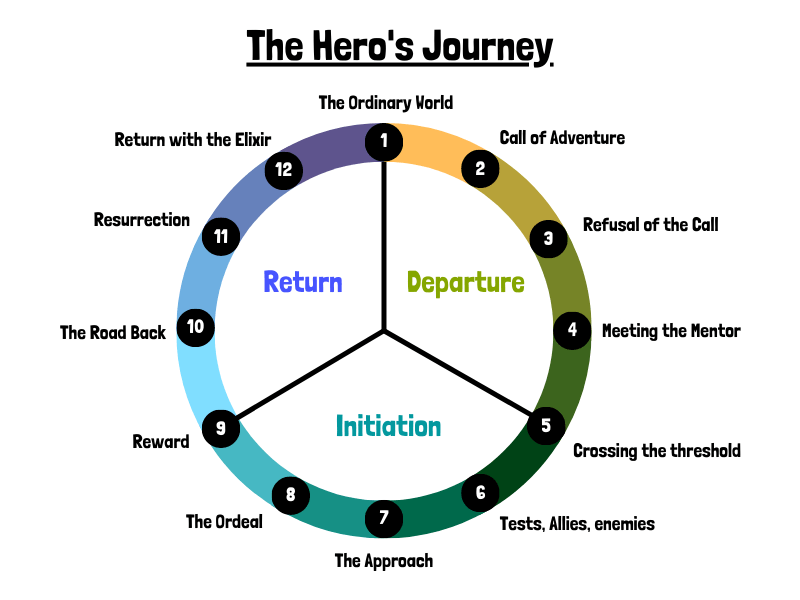
What stood out to me in their argument was the notion about the hero’s journey. They are right to challenge me on my reading of Marty never changing. How could Safdie, a knowledgeable filmmaker, make a movie about a man who doesn’t change? That would be an amateur faux pas.
Or is it a postmodern maneuver? Perhaps a trope of pulp fiction?
In creative writing classes, students are taught to craft dynamic characters who develop versus static characters who do not change.4 Colloquially speaking, dynamic characters are interesting in contrast to boring static characters. If Marty doesn’t change, then there is no point to the audience’s watching the past two-and-change-hours of his life on the silver screen. It is a “boring” movie because nothing changes.
I understand where they are coming from, but in my heart of hearts I just don’t buy that Marty will ever change. The text of the movie does not support their interpretation because Marty shows no signs of redemption—or even a desire for redemption—at any point throughout its runtime. Frankly I don’t even think Marty knows how much of an asshole he truly is.
But what is the point of the movie then? Safdie is too good to make that error and not have a point to his capital-F Film.
In my conversation with my friend, I brought up how the superhero genre is always in the second act. Similar to a soap opera, there can be no real change in the characters; they are perpetually in that second act. Can Batman ever stop being Batman and be happy? If he did, we wouldn’t be watching or reading Batman. The audience wants Bruce Wayne to struggle with his choice, but ultimately we know which option he will choose.
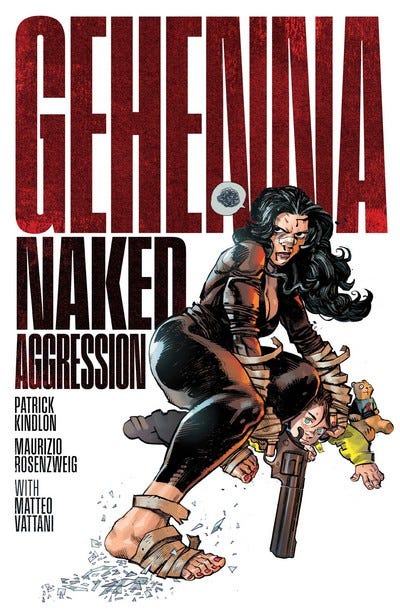
In Patrick Kindlon and Maurizio Rosenzweig’s Gehenna: Naked Aggression, the titular character is burdened with grief and a bounty on her head. At the end of the comic, not much has changed, and this is by design. Per Kindlon in the trade’s afterword:
A little bit of knowledge is a dangerous thing, and a semester of creative writing class is one of those dangerous bits. It convinced so many of us that characters need clearly defined arcs.
They don’t. That’s a convention of mid-budget film and beach paperbacks. It’s not a law for all media. Characters in comic books need opposition, which if done well means “a chance to show why they are special.” An arc is optional. And sometimes a detriment.
There’s over 150 Destroyer novels. 40 years of Punisher comic books. More than 25 Bond films. At no point did anyone request an “arc.” In fact, every time one was forced on these characters by a big-brain executive or frustrated writer, it was swiftly undone. Because that’s not what we’re there for. We want to see exceptional people do exceptional things. We want the people telling those stories to do so exceptionally. We’re not there to relate in the literal sense or see ourselves in those characters. But we do want to feel them.
The Safdie Brothers made Good Time and Uncut Gems, films about bad dudes doing shitty things because that is innately who they are as people. They suffer consequences for their actions, but their actions reveal their character, just like Marty.
Josh Safdie made Marty Supreme, an unofficial trilogy closer to their series about lousy men. These are not genre movies, but they borrow genre tropes through action. Why can’t they borrow more tropes through character?
Of course Marty Supreme is no comic book or pulp fiction novel. It’s not a piece of action cinema despite some thrilling scenes. The film is, however, spectacle, and spectacle does not necessitate character arcs. It requires only entertainment and craft, both of which Marty Supreme possesses in spades.
It’s a fine enough film, but I enjoyed Star Wars Episode VII: The Force Awakens much more. I bet Marty will age better, though. You all know I sip that haterade like it’s water.
This is unironically my favorite part of the movie. I can’t believe Safdie opened a tentpole film like this.
These are my words imperfectly paraphrasing their thoughts.
My mentors taught me this like I teach my students it now.
I didn't read the whole thing because I don't want to get spoiled, but "I will sip the haterade like water" is an all time quote for me